Physicist · 1942 – 2018
Stephen Hawking
Key Takeaways
- Hawking showed theoretically that black holes emit radiation and can slowly evaporate.
- He advanced understanding of spacetime singularities and the origin of the universe.
- His book A Brief History of Time made cosmology accessible to millions.
- He produced his work despite living for decades with motor-neurone disease.
Stephen Hawking became the most recognizable scientist of the late twentieth century — a cosmologist who probed the universe’s deepest questions from a wheelchair, his voice supplied by a computer.
Black holes that glow
Hawking’s most celebrated result, published in 1974, was startling: by combining Albert Einstein’s general relativity with the quantum theory of Max Planck, he showed that black holes are not perfectly black. They emit faint Hawking radiation and can, over immense spans of time, evaporate. With Roger Penrose he also proved theorems about the singularities at the heart of black holes and the beginning of the universe.
Science for everyone
In 1988 his book A Brief History of Time carried cosmology to millions of readers and stayed on bestseller lists for years. Holding the Cambridge chair once occupied by Isaac Newton, Hawking worked for decades with motor-neurone disease, becoming, in the modern era, a global emblem of the unbreakable human drive to understand.
Influence
Hawking united quantum theory and gravity to reveal that black holes are not entirely black, reshaping cosmology while becoming a global symbol of the life of the mind.
Legacy
He is remembered both for landmark physics and for showing how far human curiosity can reach despite profound physical limits.
Major Works
- A Brief History of Time (1988)
- The Universe in a Nutshell (2001)
Connections
Frequently Asked Questions
Who was Stephen Hawking?
Stephen Hawking (1942–2018) was a British theoretical physicist known for his work on black holes and cosmology and for his bestselling book A Brief History of Time.
What is Hawking radiation?
Hawking radiation is the theoretical prediction that black holes emit faint radiation due to quantum effects near their event horizon, allowing them to slowly lose mass.
Citations & Sources
People Like Stephen

Albert Einstein
99Albert Einstein was a German-born theoretical physicist who developed the theory of relativity, one of the two pillars of modern physics, and won the 1921 Nobel Prize.
Why Hawking extended Einstein's general relativity to black holes and the early universe.

Isaac Newton
99Isaac Newton was an English physicist and mathematician whose laws of motion and universal gravitation laid the foundation of classical mechanics and the Scientific Revolution.
Why Hawking held the Lucasian Professorship at Cambridge once held by Newton.

Max Planck
89Max Planck was a German physicist who originated quantum theory by introducing the quantum of action, a discovery that launched modern physics and earned him the 1918 Nobel Prize.
Why Hawking's work united Planck's quantum theory with gravity to predict black-hole radiation.

Erwin Schrödinger
86Erwin Schrödinger was an Austrian physicist who formulated the wave equation governing quantum systems and devised the famous Schrödinger's cat thought experiment.
Why Also a physicist · Worked in physics

James Clerk Maxwell
92James Clerk Maxwell was a Scottish physicist whose equations unified electricity, magnetism and light into a single electromagnetic theory, one of the greatest achievements in the history of physics.
Why Also a physicist · Worked in physics
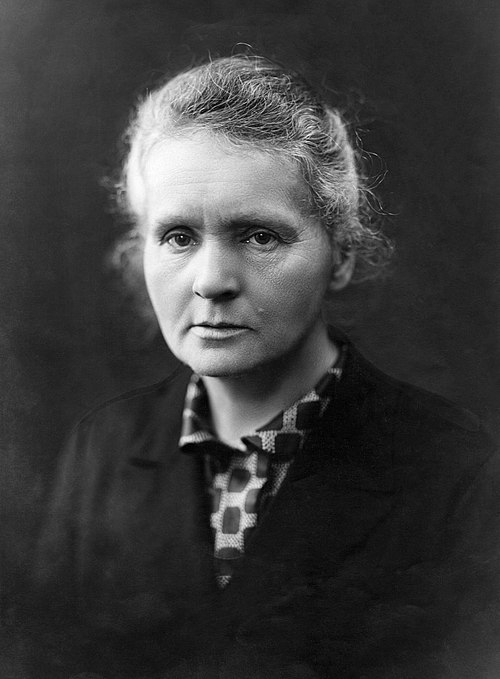
Marie Curie
92Marie Curie was a Polish-French physicist and chemist who pioneered research on radioactivity and became the first person to win Nobel Prizes in two different sciences.
Why Also a physicist · Worked in physics