General · 1807 – 1882
Giuseppe Garibaldi
Key Takeaways
- Garibaldi led the Expedition of the Thousand (1860) that conquered southern Italy.
- His campaign united southern Italy with the north, enabling Italian unification.
- He fought for republican causes in South America, Italy, and France.
- He was called the "Hero of the Two Worlds" for his campaigns in Europe and South America.
Giuseppe Garibaldi was the most romantic military figure of the 19th century — a guerrilla commander in a red shirt who fought for freedom on two continents and then handed his conquests to a king because Italy’s unity mattered more than his principles.
The Thousand
In May 1860 Garibaldi sailed from Genoa with roughly a thousand red-shirted volunteers — the Mille — and landed in Sicily. What followed was one of history’s great military adventures. His tiny force defeated the armies of the Kingdom of the Two Sicilies, swept through Sicily, crossed to the mainland, and marched north through the peninsula to Naples. The entire southern half of Italy fell in months. In October he handed his conquests to King Victor Emmanuel II of Piedmont, enabling the creation of a unified Italian kingdom.
The Hero of Two Worlds
Garibaldi had made his name long before 1860. Exiled from Italy after early revolutionary failures, he spent years fighting in South America — for Rio Grande do Sul and for Uruguay — developing the guerrilla tactics he would later bring back to Europe. His campaigns inspired Simon Bolívar’s successors and the nationalist movements of the age. He offered his military services to Abraham Lincoln; he fought for France against Prussia in 1870. When he died in 1882, Italy was united and free — his life’s work complete.
Led the Expedition of the Thousand that conquered the Kingdom of the Two Sicilies, uniting southern Italy with Piedmont-Sardinia, fought for republican causes on two continents, and became the most celebrated guerrilla leader of his age.
Military Feats
- Led the Expedition of the Thousand (Mille) to conquer the Kingdom of the Two Sicilies (1860).
- Fought guerrilla campaigns in South America (Rio Grande do Sul, Uruguay).
- Led the defense of Rome against French forces (1849).
- Commanded Italian forces in the Austro-Prussian War (1866).
Political Achievements
- Conquered southern Italy and handed it to King Victor Emmanuel II, enabling Italian unification.
- Refused personal power repeatedly, transferring his conquests to the constitutional monarchy.
Historical influence score: 84/100
Influence
Garibaldi's Expedition of the Thousand unified Italy and made him the most celebrated military-revolutionary figure of the 19th century, inspiring nationalist movements across Europe.
Legacy
Italy's national hero, his red-shirted volunteers became the symbol of romantic nationalism — his willingness to conquer and then hand over power made him a uniquely selfless revolutionary in an age of self-serving liberators.
Little-Known Facts
- He offered his military services to Abraham Lincoln at the outbreak of the American Civil War — Lincoln reportedly wanted him but negotiations broke down over Garibaldi's insistence on commanding the entire Union Army and being made a major general with authority to end slavery immediately.
- He was exiled to South America for years after early Italian revolutionary failures, fighting wars there that made his reputation as a guerrilla commander.
Myths & Misconceptions
Was Garibaldi a republican or monarchist?
He was personally a republican, but he pragmatically supported the Piedmontese monarchy as the only force capable of unifying Italy — he repeatedly conquered territories and then handed them over to the constitutional king, subordinating his republican ideals to Italian unity.
Connections
Frequently Asked Questions
Who was Giuseppe Garibaldi?
Giuseppe Garibaldi (1807–1882) was the Italian nationalist general who led the Expedition of the Thousand in 1860 to conquer southern Italy, enabling Italian unification, and who fought for republican causes on two continents.
Citations & Sources
People Like Giuseppe

Napoleon III
79Napoleon III was the nephew of Napoleon Bonaparte who became the first elected president of France and then its last emperor, modernizing Paris and French industry before his empire collapsed with defeat in the Franco-Prussian War of 1870.
Why The French emperor whose initial support for Italian unification he used, then fought against when France tried to limit the new Italy.

Otto von Bismarck
89Otto von Bismarck was the Prussian statesman who unified the German states into the German Empire in 1871, serving as its first chancellor and reshaping the balance of power in Europe through ruthless realpolitik and diplomatic mastery.
Why A contemporary nationalist statesman whose unification of Germany paralleled and competed with Garibaldi's Italian project.

Simón Bolívar
88Simón Bolívar was the South American general and statesman who liberated six nations from Spanish colonial rule, earning the title El Libertador and shaping the independence of Venezuela, Colombia, Ecuador, Peru, Panama, and Bolivia.
Why A fellow 19th-century revolutionary who inspired Garibaldi's pan-American and pan-nationalist ambitions.

Maximilien Robespierre
86Maximilien Robespierre was the French revolutionary leader who dominated the Committee of Public Safety during the Reign of Terror, using revolutionary justice to execute thousands including Louis XVI — before being overthrown and guillotined himself in Thermidor.
Why Also a revolutionary & politician · Active in the same era

Toussaint Louverture
87Toussaint Louverture was the Haitian revolutionary leader who rose from slavery to lead the only successful slave revolt in history, defeating French, Spanish, and British armies to lay the foundations for Haiti's independence as the world's first Black republic.
Why Also a general & revolutionary · Active in the same era
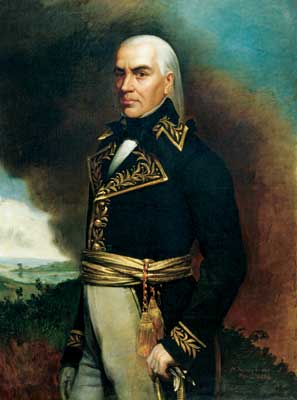
Francisco de Miranda
78Francisco de Miranda was the Venezuelan revolutionary who became the forerunner of Spanish American independence, fighting across three continents before returning home to lead Venezuela's first republic — a visionary who preceded Bolívar and inspired the liberation of Latin America.
Why Also a general & revolutionary · Active in the same era